In the Spirit of the Gracious and Compassionate
Creator of the Heavens and the Earth
The following is a short list of just a few of the most notable scholars of the Muslim civilization, many of them well-known to educated European and North American scholars.
al-Khwarizmi. Muhammad ibn Musa al-Khwarizmi (d. 863). Mathematician. Scientist. Astronomer. Geographer. Iraqi or Central Asian. Little is known about his life. May have been born in Khwarazm in Central Asia. Lived and worked in Iraq. Probably spent time in India. Author of Algebra (al-Jabr wa’l-muqabalah). Introduced Indian numbers to the Muslim world, which numbers became known in Europe as “Arabic” numbers. The
word algorism (now spelled “algorithm”) is the latinization of his name.
al-Kindi. Abu Yusuf Ya`qub ibn Ishaq al-Kindi (801-873). Latin: Alkindus. Philosopher-Scientist. Iraqi. Author of about 270 treatises on logic, philosophy, physics, mathematics, music, medicine and natural history. “Al-Kindi was the first great theoretician of music in the Arab-Islamic world. He proposed adding a fifth string to the ‘ud and discussed the cosmological connotations of music. He surpassed the achievement of the Greek musicians in using the alphabetical annotation for one eighth. He published fifteen treatises on music theory, but only five have survived. In one of his treaties the word musiqia was used for the first time in Arabic, which today means music in Arabic, Persian, Turkish, English and several other languages in the Islamic world.” http://en.wikipedia.org/wiki/Al-Kindi#Music_theory
al-Farabi. Abu Nasr al-Farabi (870-950). Latin: Alpharabius. Philosopher. Turkish, from Central Asia. Active in Baghdad, Iraq. Called the “Second Teacher” (after Aristotle, who was considered the “First Teacher”) for his complete classification of the sciences. Wrote the first great Muslim commentaries on Aristotle, at least 35 works on logic, and several independent works on physics, mathematics, ethics and political philosophy (at least 70 works, altogether). “[Al-]Farabi wrote books on early Muslim sociology and a notable book on music titled Kitab al-Musiqa (The Book of Music). He played and invented a varied number of musical instruments and his pure Arabian tone system is still used in Arabic music. Al-Farabi’s treatise Meanings of the Intellect dealt with music therapy, where he discussed the therapeutic effects of music on the soul.” http://en.wikipedia.org/wiki/AlFarabi#Music_and_sociology
Alhazen. Ḥasan Ibn al-Haytham (965 – c. 1040) was an Arab mathematician, astronomer, and physicist. Referred to as “the father of modern optics”, he made significant contributions to the principles of optics and visual perception in particular. His most influential work is titled Kitāb al-Manāẓir (“Book of Optics”). He also wrote on philosophy, theology and medicine.
Ibn al-Haytham was the first to explain that vision occurs when light reflects from an object and then passes to one’s eyes. He was also the first to demonstrate that vision occurs in the brain, rather than in the eyes. Building upon a naturalistic, empirical method, Ibn al-Haytham was an early proponent of the concept that a hypothesis must be supported by experiments based on confirmable procedures or mathematical evidence—an early pioneer in the scientific method six centuries before Galileo. (https://en.wikipedia.org/wiki/Ibn_al-Haytham)
ibn Sina. Abu `Ali al-Husain ibn Sina (980-1037). Latin: Avicenna. Philosopher. Scientist. Physician. Central Asian. Author of 250 works. His best known work is the Canon of Medicine, translated into Latin and taught for centuries in European universities, and one of the most frequently printed scientific texts in the Renaissance. Major influence on Albertus Magnus, St. Thomas Aquinas, Duns Scotus and Roger Bacon.
Omar Khayyam. Abu’l-Fath `Umar ibn Ibrahim al-Khayyami (1038/1048-1123/1132). Mathematician. Poet. Iranian. Author of Algebra, best medieval text on this subject.
ibn Rushd. Abu’l-Walid Muhammad ibn Rushd (1126-1198). Latin: Averroes. Philosopher. Judge. Physician. Spanish. Greatest medieval commentator on Aristotle. Author of numerous commentaries on the works of Aristotle in addition to independent works on astronomy, physics and medicine.
ibn Khaldun. `Abd al-Rahman Abu Zaid ibn Khaldun (1332-1406). Historian. Philosopher of history. Born in Tunis, North Africa, of Spanish ancestry. His Kitab al-`Ibar begins with the famous Muqaddimah (Introduction), analyzing the causes for the rise and fall of civilizations and cultures, summarizing the sciences and discussing the reasons for their cultivation in some periods and lack of interest in them in others. Author of works on mathematics, theology and metaphysics. Royal secretary to various rulers.
Ahmad Baba, of Timbuktu (1556-1627). Legal scholar. President of the University of Sankore. Author of over forty books, including a biographical dictionary of Muslim scholars in Western Africa. Wrote an astronomy book in verse.
Mahmoud Kati, of Timbuktu (1468-1593; 125 years). Historian. Author of Tarikh al-Fattash, a history of West Africa, covering the period up to 1665 (completed by his sons and grandsons). I possess a copy of a fairly recent English translation of this book (https://africaworldpressbooks.com/the-timbuktu-chronicles-1493-1599-al-hajj-mahmud-katis-tarikh-al-fattish-edited-by-christopher-wise-translated-by-christopher-wise-hala-abu-taleb/). (Mahmoud Kati is not well documented in Wikipedia; whoever wrote the article on Tarikh al-Fattash has difficulty accepted his reported life-span of 125 years as factual. My information on Mahmoud Kati came initially from A History of West Africa by Basil Davidson — a simple paperback that seems to have become difficult to obtain from Amazon.com. According to an amazing blog post, Mahmoud Kati is a descendant of Muslims who had been expelled from Spain.)
as-Sadi. Abdur-Rahman as-Sa`di, of Timbuktu (1596-1656). Historian. Author of Tarikh as-Sudan, a history of West Africa to 1656. (As-Sa`di is not documented in Wikipedia, apart from being mentioned as the author of Tarikh as-Sudan. Again, my original source is Basil Davidson’s history of West Africa.)
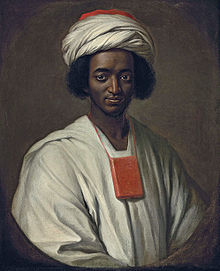
Ayuba ibn Suleiman Diallo (1701-1773) (illustrated above), also known as Job Ben Solomon, merchant, considered Arabic scholar in England, helped Hans Sloane establish the Arabic section of the British Museum. He had been captured and sold into slavery, and was enslaved in the Maryland colony from 1730 to 1733, before being ransomed by James Oglethorpe (founder of the Georgia colony) and transported to England. (https://en.wikipedia.org/wiki/Ayuba_Suleiman_Diallo)
Partial List of Sources:
Nasr, Seyyed Hossein. Science and Civilization in Islam. New York: New American Library, 1970
Davidson, Basil. A History of West Africa (to the Nineteenth Century). Garden City: Anchor Books, 1966 (for scholars of Timbuktu)
Grant, Douglas. The Fortunate Slave: An Illustration of African Slavery in the Early Eighteenth Century. London: Oxford University Press, 1968)
24 Rabee`-al-Aakhar 1433 / 22 Shawwaal 1442 / 16 Muharram 1443
March 17, 2012 / June 3, 2021 / August 24, 2021
 Which Way Is Up?